
Catalysis for energy
The unique redox, electronic and ionic properties of non-stoichiometric oxides, including ceria, transition-metal oxides and perovskites, make these materials highly attractive not only for catalysis but also for advanced energy conversion technologies. Our research explores the fundamental relationships between composition, structure, redox behaviour, electronic properties and catalytic performance across different classes of functional oxides. This knowledge is used to design and develop materials for electrochemical energy conversion systems, including solid oxide fuel cells and solid-state electrochemical cells. A major research direction is also dedicated to green hydrogen technologies. We investigate catalytic materials and processes for hydrogen production from renewable resources, including solar-derived pathways and biogas, as well as its use as a clean energy vector for the decarbonisation of energy-intensive industrial processes and the sustainable production of fuels and chemicals. By combining catalysis, materials chemistry and electrochemistry, we aim to understand the fundamental mechanisms governing energy conversion processes and translate this knowledge into innovative materials and technologies for a more sustainable energy system. Our research follows a strongly interdisciplinary approach and is carried out in close collaboration with leading national and international research institutions, including Politecnico di Torino, Politecnico di Milano and the Massachusetts Institute of Technology (MIT).
Selected publications
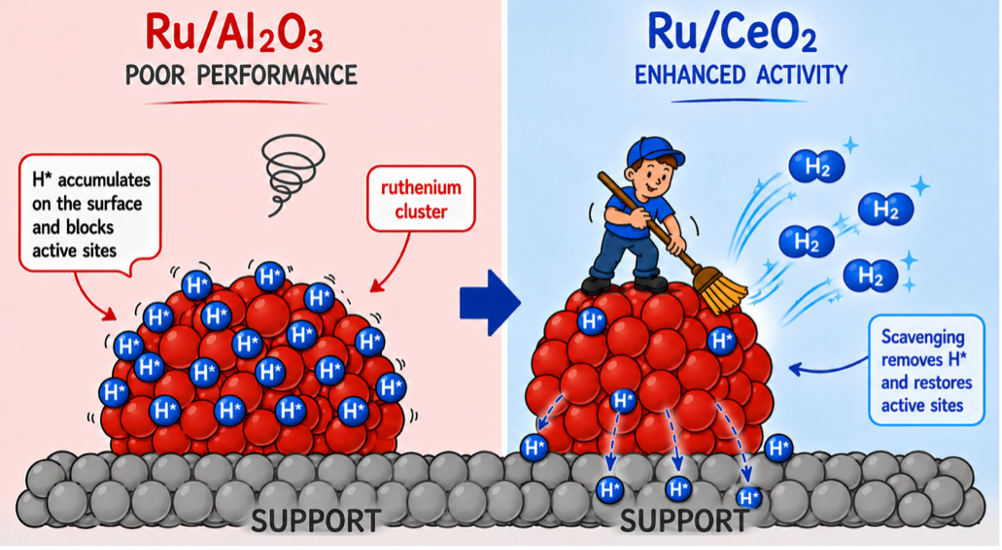
Unravelling the kinetics of NH3 decomposition over highly active Ru/CeO2 catalysts: Effect of the support on H-poisoning and rate determining steps
I. Conti, D. Quattrin, Y. Qiu, A. Trovarelli and A. Beretta
Chem. Eng. Journal 546 (2026) 180111
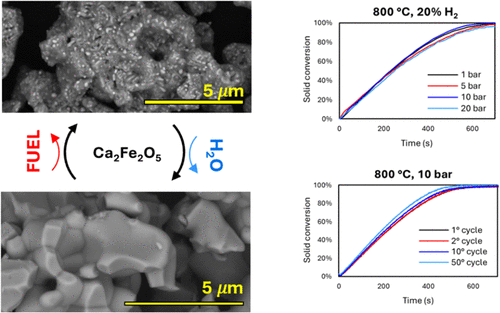
High-Pressure Reduction Kinetics of Ca2Fe2O5 for Advanced Chemical Looping Steam Reforming
A. Strazzolini, R. Ramezani, G. de Felice, L. di Felice, C. de Leitenburg, A. Trovarelli, M. Boaro, and F. Gallucci
Ind. Eng. Chem. Res 64 (2025) 9914-9924
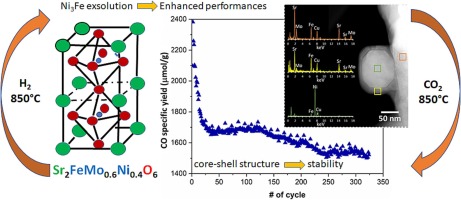
Exsolution-enhanced reverse water gas shift chemical looping activity of Sr2FeMo0.6Ni0.4O6-d double perovskite
F. Orsini, D. Ferrero, S.F. Cannone, M. Santarelli, A. Felli, M. Boaro, C. de Leitenburg, A. Trovarelli, J. Llorca, G. Dimitrakopoulos, A. F. Ghoniem
Chem. Eng. Journal 475 (2023) 146083
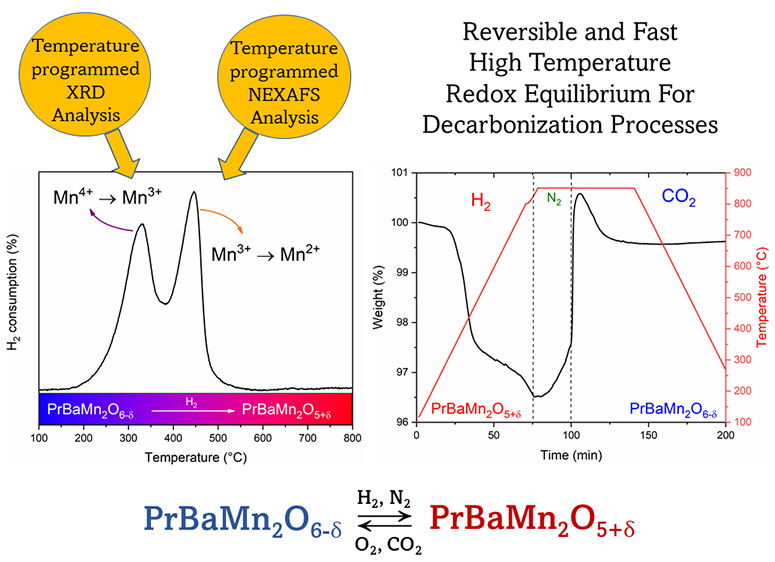
Insights into the Redox Behaviour of Pr0.5Ba0.5MnO3-d Derived Perovskites for CO2 Valorization Technologies
A. Felli, S. Mauri, M. Marelli, P. Torelli, A. Trovarelli, M. Boaro
ACS Appl. Energy Materials, 5 (2022) 6687-6699.
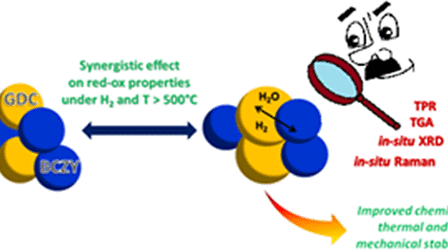
Insights on the Interfacial Processes Involved in the Mechanical and Redox Stability of the BaCe0.65Zr0.20Y0.15O3-d-Ce0.85Gd0.15O2-d Composite
C. Mortalò, M. Boaro, E. Rebollo, V. Zin, E. Aneggi, M. Fabrizio, A. Trovarelli
ACS Appl. Energy Materials, 3 (2020) 9877-9888.
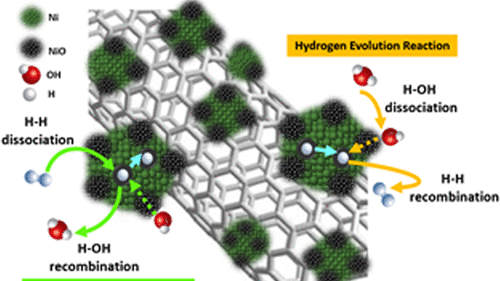
NiO-Ni/CNT as an Efficient Hydrogen Electrode Catalyst for a Unitized Regenerative Alkaline Microfluidic Cell
C.A. Campos-Roldán, L. Calvillo, M. Boaro, R. De Guadalupe González-Huerta, G. Granozzi, N. Alonso-Vante.
ACS Appl. Energy Materials, 3 (2020) 4746-4755.
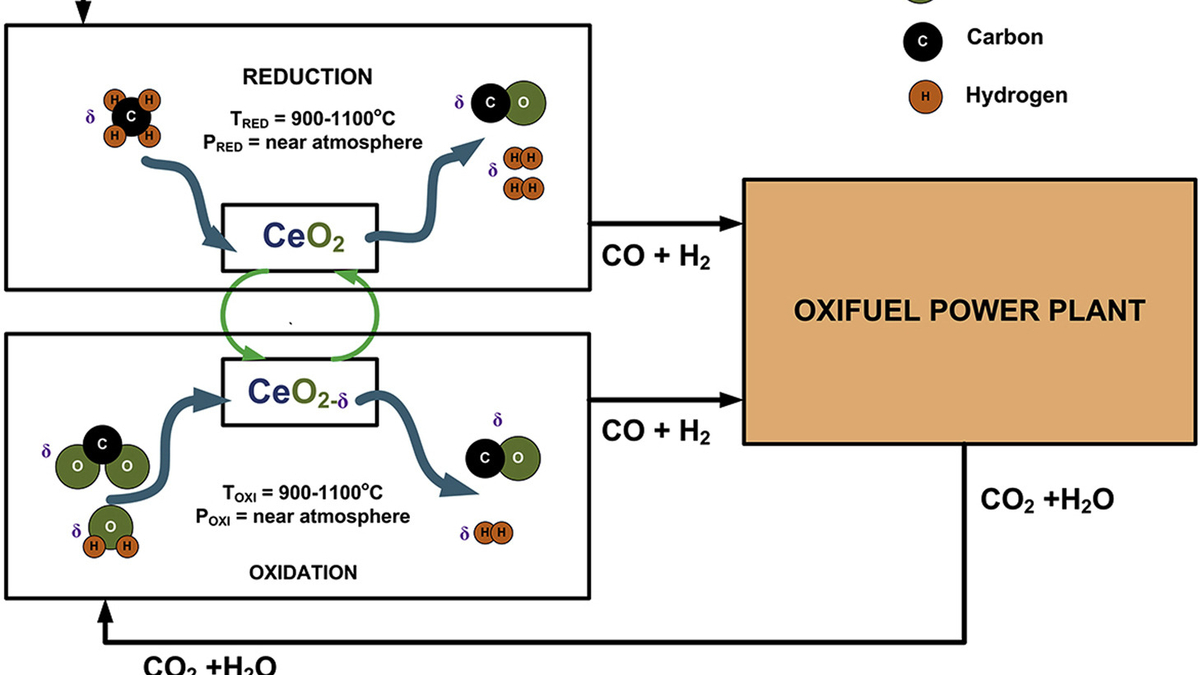
Assessment of integration of methane-reduced ceria chemical looping CO2/H2O splitting cycle to an oxy-fired power plant
A. Farooqui, A. Bose, M. Boaro, J. Llorca, M. Santarelli
Int. J. Hydrogen Ener., 45 (2020) 6184-6206.
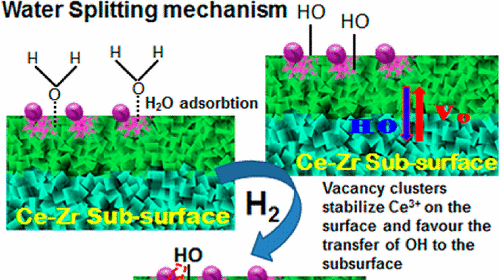
New Insights into the Dynamics that Control the Activity of Ceria-Zirconia Solid Solutions in Thermochemical Water Splitting Cycles
A. Pappacena, M. Rancan, L. Armelao, J. Llorca, W. Ge, B. Ye, A. Lucotti, A. Trovarelli, M. Boaro
J. Phys. Chem. C, 121 (2017) 17746-17755.

Infiltration, overpotential and ageing effects on cathodes for solid oxide fuel cells: La0.6Sr0.4Co0.2Fe0.8O3-δ versus Ba0.5Sr0.5Co0.8Fe0.2O3-δ
A. Giuliano, M.P. Carpanese, D. Clematis, M. Boaro, A. Pappacena, F. Deganello, L.F. Liotta, A. Barbucci
J. Electrochem. Soc., 164 (2017) F3114-F3122.
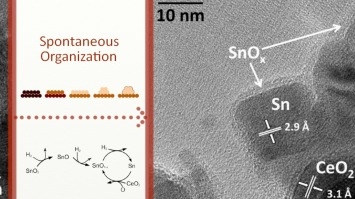
Structural and electrocatalytic properties of molten core Sn@SnOx nanoparticles on ceria
L. Bardini, A. Pappacena, M. Dominguez-Escalante, J. Llorca, M. Boaro, A. Trovarelli
Appl. Catal, B: Environ., 197 (2016) 254-261.