
Activation of small molecules
The catalytic activation and conversion of small molecules such as CO, CO2, CH4, H2O and NOₓ is central to the development of more sustainable chemical and energy technologies. Rather than being regarded solely as waste products or stable end molecules, many of these species can serve as valuable feedstocks for the production of chemicals, fuels and energy carriers. Their activation, however, remains a major challenge in catalysis because of their high thermodynamic and kinetic stability. Efficient conversion therefore requires catalysts capable of combining high activity, selectivity and stability, while enabling precise control over reaction pathways. For nearly three decades, our group has been investigating ceria-based and ceria-containing catalytic materials, exploiting the unique redox properties, oxygen storage capacity and structural versatility of ceria to promote catalytic activity and tune the selectivity of metal-based systems. A central theme of our research is the understanding and control of metal–support interactions, which can profoundly modify the electronic, structural and catalytic properties of the active phase. Our goal is to uncover the fundamental structure–activity–selectivity relationships governing catalytic performance and to use this knowledge to guide the rational design of more efficient catalysts. To achieve this, we combine advanced materials characterization with conventional, in situ and operando techniques, using facilities available in our laboratories and through collaborations with national and international research partners.
Selected publications
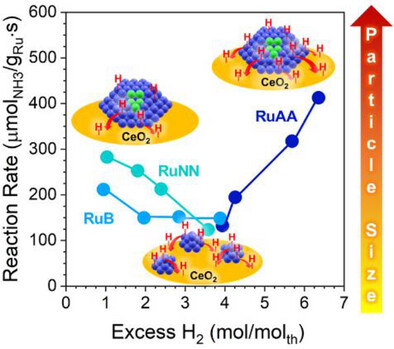
Parametric Study on Ru/CeO2 Ammonia Decomposition Catalysts for Hydrogen Production
A. Felli, M. Danielis, A. Trovarelli, and S. Colussi
ChemCatChem 17 (2025) e00585
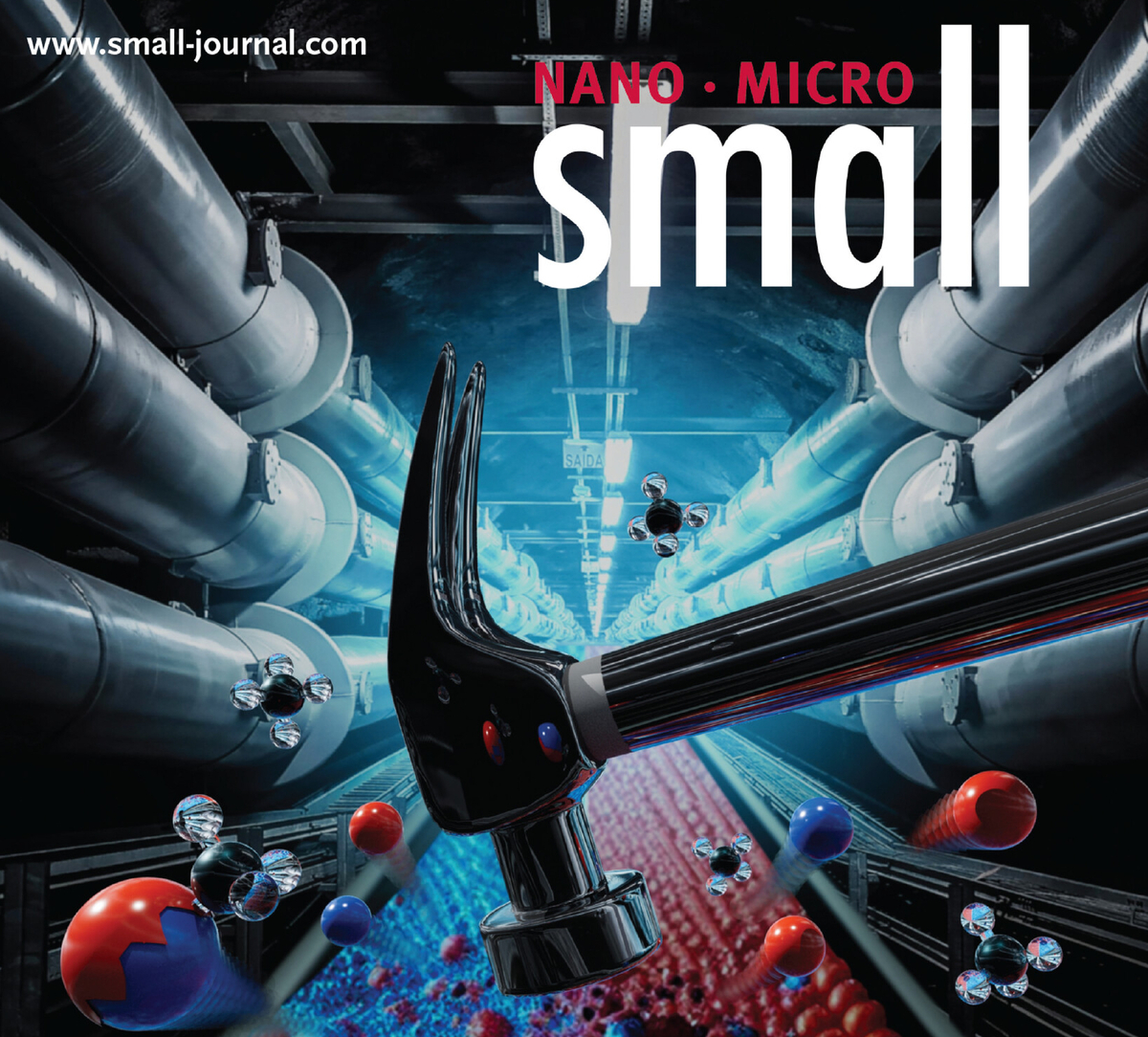
Low-Temperature Methane Activation Reaction Pathways over Mechanochemically-Generated Ce4+/Cu+ Interfacial Sites
S. Mauri, R. Calligaro, C. F. Pauletti, M. Farnesi Camellone, M. Boaro, L. Braglia, S. Fabris, S. Piccinin, P. Torelli, A. Trovarelli
Small 20 (2024) 2403028

Investigation of the evolution of Pd-Pt supported on ceria for dry and wet methane oxidation
N. J. Divins, A. Braga, X. Vendrell, I. Serrano, X. Garcia, L. SOler, I. Lucentini, M. Danielis, A. Mussio, S. Colussi, I.J. Villar-Garcia, C. Escudero, A. Trovarelli, J. Llorca
Nature Commun., 13 (2022) 5080.
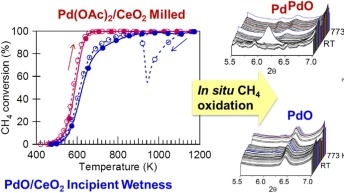
Methane oxidation activity and nanoscale characterization of Pd/CeO2 catalysts prepared by dry milling Pd acetate and ceria
M. Danielis, L.E. Betancourt, I. Orozco, N.J. Divins, J. Llorca, J.A. Rodríguez, S.D. Senanayake, S. Colussi, A. Trovarelli
Applied Catalysis B: Environmental, 282 (2021) 119567.

Structure-activity relationship in Pd/CeO2 methane oxidation catalysts
S. Colussi, P. Fornasiero, A. Trovarelli
Chinese J. Catal., 41 (2020) 938-950.
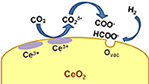
Ceria-Based Materials in Hydrogenation and Reforming Reactions for CO2 valorization
M. Boaro, S. Colussi, A. Trovarelli
Front. Chem., 7 (2019) 28.
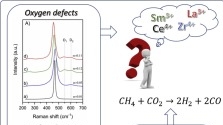
Dry reforming of methane over Ni supported on doped CeO2: New insight on the role of dopants for CO2 activation
I. Luisetto, S. Tuti, C. Romano, M. Boaro, E. Di Bartolomeo, J.K. Kesavan,S. S. Kumar, K. Selvakumar
J. CO2 Utilization, 30 (2019) 63-78.
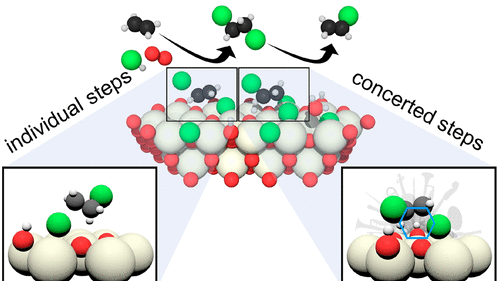
Mechanism of Ethylene Oxychlorination on Ceria
M. Scharfe, M. Capdevila-Cortada, V. A. Kondratenko, E.V. Kondratenko, S. Colussi, A. Trovarelli, N. López, J. Pérez-Ramírez
ACS Catal., 8 (2018) 2651-2663.